
Why a WBS Makes Project Reporting More Accountable
Project reporting often fails for a simple reason: it describes activity without making responsibility clear. Teams say work is “in progress,” milestones are reported as “slipping,” and status updates are filled with broad statements that sound informative but do not support action.
When reporting is vague, accountability becomes vague as well. Problems can linger too long, ownership can become blurred, and leaders may not understand the true source or impact of emerging issues until performance has already deteriorated.
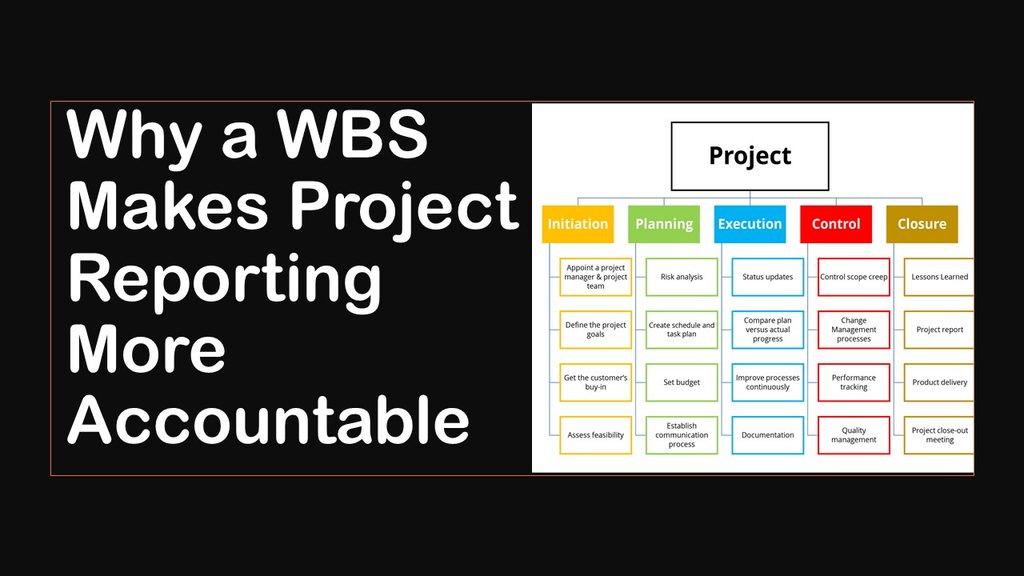
A well-structured work breakdown structure (WBS) helps solve this problem. It improves reporting accountability by making ownership explicit at the right level of detail. Rather than treating the project as one large stream of activity, the WBS breaks the work into defined deliverables and work packages. Each of those elements can then be assigned to a specific owner, team, or control account. That structure turns reporting from a general narrative into a traceable performance system.
This matters because accountability depends on precision. If a report says, “testing is delayed,” the statement may be true, but it is not very useful. Which part of testing is delayed? Who owns it? How far behind is it? What other deliverables does it affect?
A WBS makes it possible to answer those questions. Instead of a vague update, the project team can report that WBS element 2.3.1 is 15 percent behind plan, is owned by the integration team, and is affecting the interface milestone. That kind of reporting immediately creates clarity. It identifies the work, the owner, the variance, and the consequence. It becomes much harder for issues to stay hidden behind general language.
A WBS also strengthens accountability because it ties reporting to clearly bounded scope. Each work package should represent a defined piece of deliverable-oriented work. When that element is supported by acceptance criteria, planned dates, budget expectations, and resource assignments, the responsible party has an objective basis for reporting status. Progress is no longer a matter of opinion. It is measured against something concrete.
That distinction is important. In many projects, reporting breaks down because terms such as “done,” “almost done,” or “on track” mean different things to different people. One team may report progress based on effort spent, while another may report based on tasks started, and another may wait for formal acceptance. Without a common structure, performance reporting becomes inconsistent and open to interpretation.
A WBS reduces that ambiguity. Because each scope element is defined, the owner can report progress against a known deliverable rather than against a subjective impression of movement. Accountability becomes fairer and stronger because everyone is measured against explicit expectations.
Another advantage is that the WBS makes variance traceable. Good reporting is not only about showing status; it is about explaining deviation from plan. When schedule, cost, quality, or scope performance varies, managers need to know exactly where the variance originates. A WBS gives them that visibility. Since the work is organized into discrete components, a negative variance can be traced to a specific part of the project rather than lost inside aggregated totals.
This improves both management control and team accountability. If a milestone is at risk, leaders do not need to rely on guesswork or broad departmental summaries. They can identify the exact WBS elements that are contributing to the slippage. They can see who owns them, what was planned, what has actually occurred, and what corrective action may be required. In that environment, accountability is not punitive; it is operational. People know what they own, and managers know where to focus support, escalation, or intervention.
The WBS supports accountability upward as well as downward. Reporting is most effective when it connects local ownership to overall project outcomes. The WBS enables this by allowing data to roll up from work packages to higher-level deliverables and then to the full project. A delay at one lower-level element does not remain isolated. Its impact can be seen in the broader reporting structure. This helps managers understand not only who owns a local issue, but also how that issue affects program objectives, customer commitments, or downstream dependencies.
That roll-up capability is one of the most powerful features of WBS-based reporting. It creates a direct link between individual reporting responsibility and project-level decision making. A team lead cannot dismiss a variance as minor if the WBS shows that it affects a major milestone. Likewise, senior leaders do not need to overreact to a local problem if the roll-up shows minimal project impact. The structure supports proportionate, evidence-based decisions.
In practice, a WBS improves reporting accountability in four connected ways. First, it clarifies who owns each scope element. Second, it defines what progress should be measured against. Third, it enables variances to be traced to specific parts of the project. And, fourth, it supports escalation with evidence rather than opinion. Together, these features make reporting more transparent, more defensible, and more actionable.
That is why the WBS should not be treated as a planning artifact that is created once and then forgotten. It is a reporting foundation. When used well, it turns status reporting into performance reporting and performance reporting into decision support. It helps teams speak precisely about what is happening, where it is happening, who owns it, and what it means for the project as a whole. In the end, accountability improves when people can no longer hide behind broad statements. A WBS creates the structure that makes clear ownership visible and measurable. And when ownership is visible, reporting becomes not just more accurate, but far more useful.