How Project Management Skills Impact Your Career Part 2
Most professionals regard project management as a technical skill – something you use to keep a schedule on track or a budget under control. In my experience, it is something far bigger than that. It is one of the few skill sets that directly reshapes your career horizon – how far, how fast, and how widely your career can grow.
In part 1 of this essay, I outlined the negative impacts that the lack of project management skills can have on your career, and what to do about it.
Now, in this essay I will present what a strong project management capability actually can do for you.
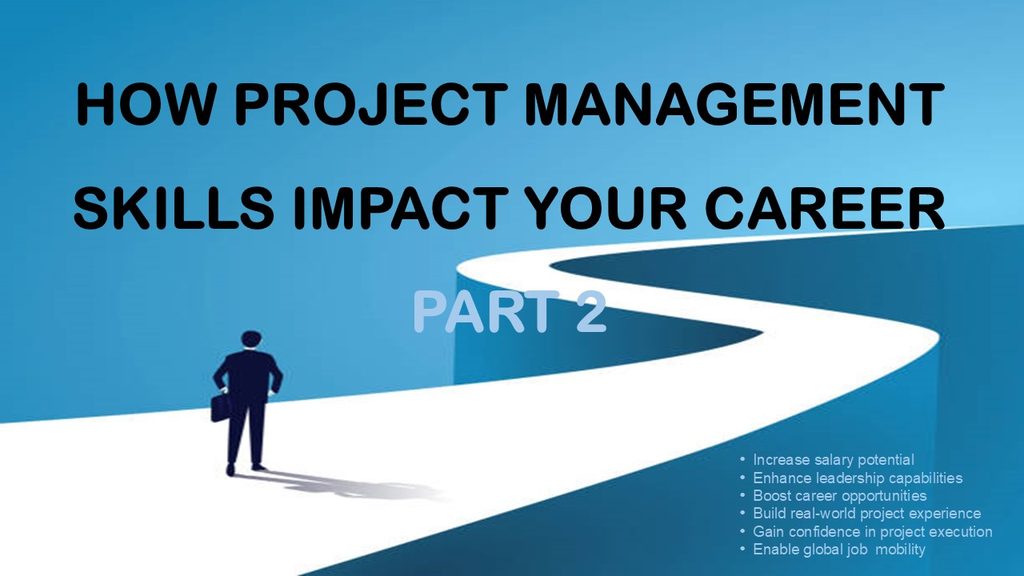
1. Increases Salary Potential
Compensation tends to follow responsibility, and responsibility tends to follow proven delivery. Professionals who can plan complex work, manage stakeholders and risk, and consistently produce results are trusted with higher-value initiatives – and higher-value initiatives come with stronger compensation. This is not a coincidence. Organizations pay for outcomes, and project management is the discipline that reliably produces them.
2. Enhances Leadership Capabilities
Leadership is often framed as a personality trait, but in practice, it is built from specific skills – planning, decision-making under uncertainty, clear communication, and accountability for results. Project management develops all four simultaneously, because a project forces you to exercise them in real conditions, with real constraints and real people depending on you. The more projects you lead, the more these capabilities become instinctive rather than effortful.
3. Boosts Career Opportunities
One of the most underappreciated benefits of project management is how many doors it opens. These skills are not confined to a single job title – they transfer directly into team leadership, program coordination, operations management, and general management roles across most industries. Once you have demonstrated that you can plan and deliver complex work, you become a candidate for far more than your original technical lane.
4. Builds Real-World Project Experience
Reading about project management is one thing. Practicing it is a totally different animal. Every time you apply the fundamentals – scoping work properly, sequencing tasks, managing stakeholders, adjusting when conditions change – you accumulate practical experience that no classroom can fully replicate. This is the experience that shows up in interviews, in performance reviews, and in the quiet confidence of knowing you have actually delivered complex outcomes before, not just studied how to.
5. Builds Confidence in Project Execution
Uncertainty is the normal condition of any meaningful project. What separates confident professionals from anxious ones is not the absence of uncertainty – it is having a structure to work through it. Knowing how to plan, track progress, communicate clearly, and adapt when circumstances shift gives you a repeatable process to lean on. That structure is what allows you to walk into a complex project and feel equipped rather than overwhelmed.
6. Enables Global Job Mobility
Project management is one of the most transferable skill sets in the modern workforce. Unlike highly specialized technical knowledge that may only apply within a single industry or region, the discipline of planning, executing, and delivering projects is valued across countries, sectors, and functions. This is precisely what has made it possible for experienced project management practitioners to work across international markets over the course of their careers – the fundamentals travel, even when the industry or geography changes.
The Bigger Picture
Taken together, these six advantages point to a single truth: project management is not a niche technical skill – it is a career accelerant. It strengthens your earning potential, sharpens your leadership presence, widens your career options, builds genuine execution confidence, and gives you the mobility to pursue opportunities wherever they arise. This is how professionals move from being task contributors to becoming capable, trusted leaders.
The professionals who advance fast are rarely the ones who wait for these skills to develop naturally on the job. They are the ones who invest deliberately in building them – through structured learning, practical frameworks, and guidance from people who have applied these principles in real, high-stakes environments.
That is the foundation I built Project Management Fundamentals on – drawing from decades of delivering complex EPC/EPIC projects for operators like Shell, Chevron, Addax, and Qatar Petroleum, distilled into practical skills you can start applying immediately, wherever you are in your career.
If you are ready to build the skills that open doors rather than wait for them to open on their own, you can explore the course here.