A $10.8 Million Mistake: What the Montreal Overpass Fiasco Teaches About Project Management
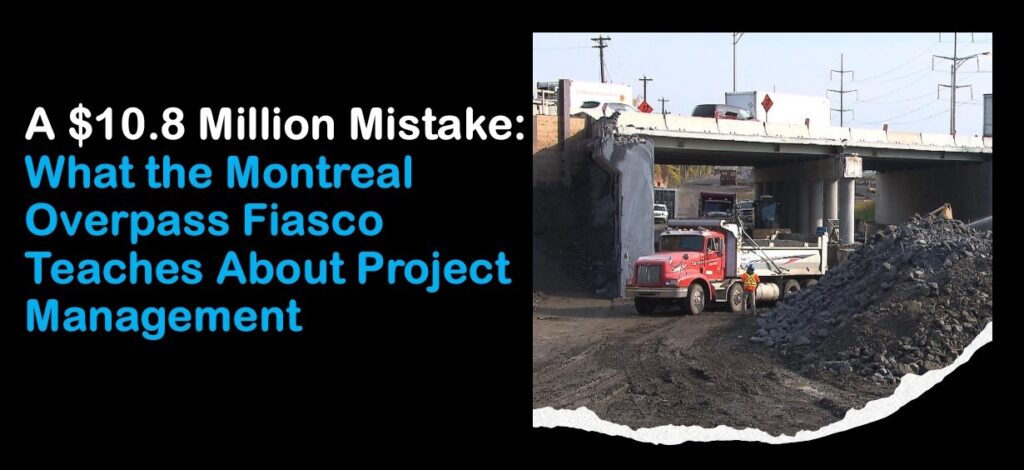
In Montreal, Canada, a perfectly functional overpass was demolished just one year after it opened to the public. The Highway 15 overpass, built at a cost of USD $10.8 million, was torn down because it didn’t align with the redesigned access routes to the nearby Champlain Bridge – a bridge that was, at the time of construction, already undergoing its own major redevelopment.
The government’s defense was that the original overpass had become dangerous and needed immediate replacement, and that the Champlain Bridge’s final design had not yet been settled. Reasonable explanations, perhaps. But they raise a deeper, more uncomfortable question: how was a $10.8 million infrastructure decision made in isolation from one of the most consequential road redesign projects in the same geographic corridor?
Well, the answer, in project management terms, is a breakdown in three critical disciplines – program management, interface management, and effective communication. These are not abstract academic concepts. They are practical tools that, when applied correctly, prevent exactly this kind of costly, avoidable disaster.
The Program Management Failure
Program management is the coordinated management of related projects in a way that delivers benefits and controls that would not be achievable from managing them individually. The Highway 15 overpass and the Champlain Bridge access redesign were not independent projects. They shared geography, traffic flows, budget implications, and – most importantly – interdependent design decisions. They were, by every definition, part of the same program.
But when related projects are managed in isolation, decisions made on one inevitably conflict with decisions made on the other. That is precisely what happened here. The overpass replacement was treated as a standalone infrastructure fix, with its own timeline, design, and project team. Meanwhile, the Champlain Bridge access redesign was evolving on a separate track. No one was sitting above both projects, looking at the full picture, asking the critical question: how does this decision interact with what’s happening over there?
That is exactly what a program manager would have done. Their role is to identify interdependencies and associated risks, manage shared resources, and ensure that decisions made on one project do not negatively impact or foreclose better options on another. In this case, even a basic program-level review would have flagged the risk: we are about to spend $10.8 million on a structure whose long-term alignment depends on a design process that isn’t finalized yet. What are our options?
Temporary repair or a staged solution or even a deliberate delay while the Champlain Bridge design settled. Any of these options might have been viable. But they were never seriously explored because no one was looking at both projects together.
The Interface Management Failure
Interface management is the formal process of identifying, documenting, and controlling the points where two or more projects interact – whether physically, operationally, or contractually. It is one of the most underutilized disciplines in large-scale infrastructure delivery, and one of the most consequential when ignored.
The intersection between Highway 15 and the Champlain Bridge access road was, quite literally, a major interface. The alignment of the overpass directly depended on the final design of the bridge access road. That dependency should have been formally documented, owned, and tracked.
In practice, interface management requires both project teams to agree on a set of interface requirements – the physical and functional parameters that each project must honor to ensure they integrate correctly. Had this been done, the overpass project team would have known from the outset that one of their key design inputs – the road alignment coming off the Champlain Bridge – was still in flux. That single data point should have triggered a risk flag, a design freeze condition, or at minimum, a conversation about whether to proceed.
Instead, the overpass construction just assumed a road alignment that subsequently changed. The interface was never managed. The result was a structure that fit perfectly on its own terms and failed completely in context.
The Communication Failure
Underlying both failures mentioned above is a communication failure – not in the sense of people not talking to each other, but in the structured, deliberate sense of stakeholder communication and information governance that effective project management demands.
Effective communication in project management means ensuring that the right information reaches the right people at the right time, in a form they can act on. It means establishing clear reporting lines between related projects. It also means creating forums – steering committees, program boards, design integration meetings – where interdependencies or interfaces can be surfaced and resolved before they become expensive mistakes.
Of course, it also means asking the hard questions. In this case, someone should have asked: who are the stakeholders of this overpass project who are not currently in the room? Who is responsible for the Champlain Bridge redesign? Are they aware of what we are about to build? Have they confirmed that our design assumptions are consistent with their current thinking?
These are not difficult questions. But they require a culture and a structure in which communication flows across project boundaries, not just within them. When projects are run in siloes – each with its own team, reporting lines, and definition of success – cross-cutting questions don’t get asked. And $10.8 million gets spent on a structure that lasts just twelve months!
What Good Looks Like
To be clear, this is not about assigning blame to individual engineers or project managers. Large infrastructure programs are genuinely complex, and the people working on them are often doing their best within systems that don’t support cross-project thinking. The failure here is systemic.
What would a good program governance have looked like in this case?
A program-level oversight body would have been established, with visibility across both the Champlain Bridge redevelopment and all adjacent infrastructure directly affected. Any replacement or upgrade within that corridor would have required sign-off at the program level before proceeding to detailed design.
Also, interface dependencies would have been formally logged, with a named owner on each side responsible for monitoring changes and escalating conflicts. And the communication framework would have ensured that a design change on the Champlain Bridge access road automatically triggered a review of all dependent structures – including the Highway 15 overpass.
None of this is nuclear science. These are standard practices in well-run infrastructure programs. They exist because, without them, exactly this kind of expensive, embarrassing, and entirely preventable failure occurs.
The Lesson Is Transferable
The Montreal overpass is a dramatic example, but the underlying failure pattern is not unusual. Across industries and at every scale, projects that should be managed as part of a coordinated program are instead run independently, creating conflicts that only become visible – and costly – at the point of integration.
Whether you are managing a construction project, a technology transformation, a product launch, or an organizational change, the disciplines are the same. Understand the broader context in which your project sits. Identify and manage the interfaces – the points where your work depends on, or affects, someone else’s. And communicate deliberately and structurally, not just with the people already in the room, but with everyone who has a stake in the outcome.
These are learnable skills. And learning them, before the decisions are made, is always cheaper than learning from the wreckage.
Ready to Build These Skills?
The Montreal overpass didn’t have to cost $10.8 million twice. It needed one thing: professionals who understood how to manage related projects as a coherent whole.
My Project Management Fundamentals course teaches exactly these disciplines – program management, interface management, and structured communication – through real-world, industry-tested frameworks from a practicing consultant that you can apply immediately. Whether you are new to project management or an experienced professional looking to sharpen your practice, this course will equip you with the tools and skills necessary to see the full picture, identify and manage the connections, and make decisions that ensure the success of the individual projects and the program as a whole.Don’t let the next expensive mistake happen on your watch. Register for Project Management Fundamentals today.